
200 Pcs Cable Clips
4.5Editor score
Four cable size options
Two hundred nail-in clips
Suitable for many cable types
Cable anchor clips keep cords organized along walls, trim, siding, and other suitable surfaces while reducing loose cable hazards. The right clip depends on cable diameter, mounting material, exposure to weather, installation method, and whether a low-profile nail clip or screw-secured clamp better suits the project.
This guide compares ten cable anchor clip products using the supplied ratings, construction details, installation features, intended applications, and pack contents. It covers nail-in, screw-mounted, stucco-specific, and zip-tie saddle options for coax, Ethernet, electrical, speaker, USB, and decorative cables.
Each review explains where the product is strongest, where its design requires compromise, and which users may benefit most. Ratings and product details reflect the available information, while availability and pricing can change, so readers should confirm current listing details before purchasing.
4.5Editor score

4.7Editor score

4.8Editor score
As an Amazon Associate we earn from qualifying purchases.
The following comparison highlights each clip's mounting style, material approach, cable compatibility, and best-fit installation scenario so shoppers can compare the ten options without overlooking an important design distinction.

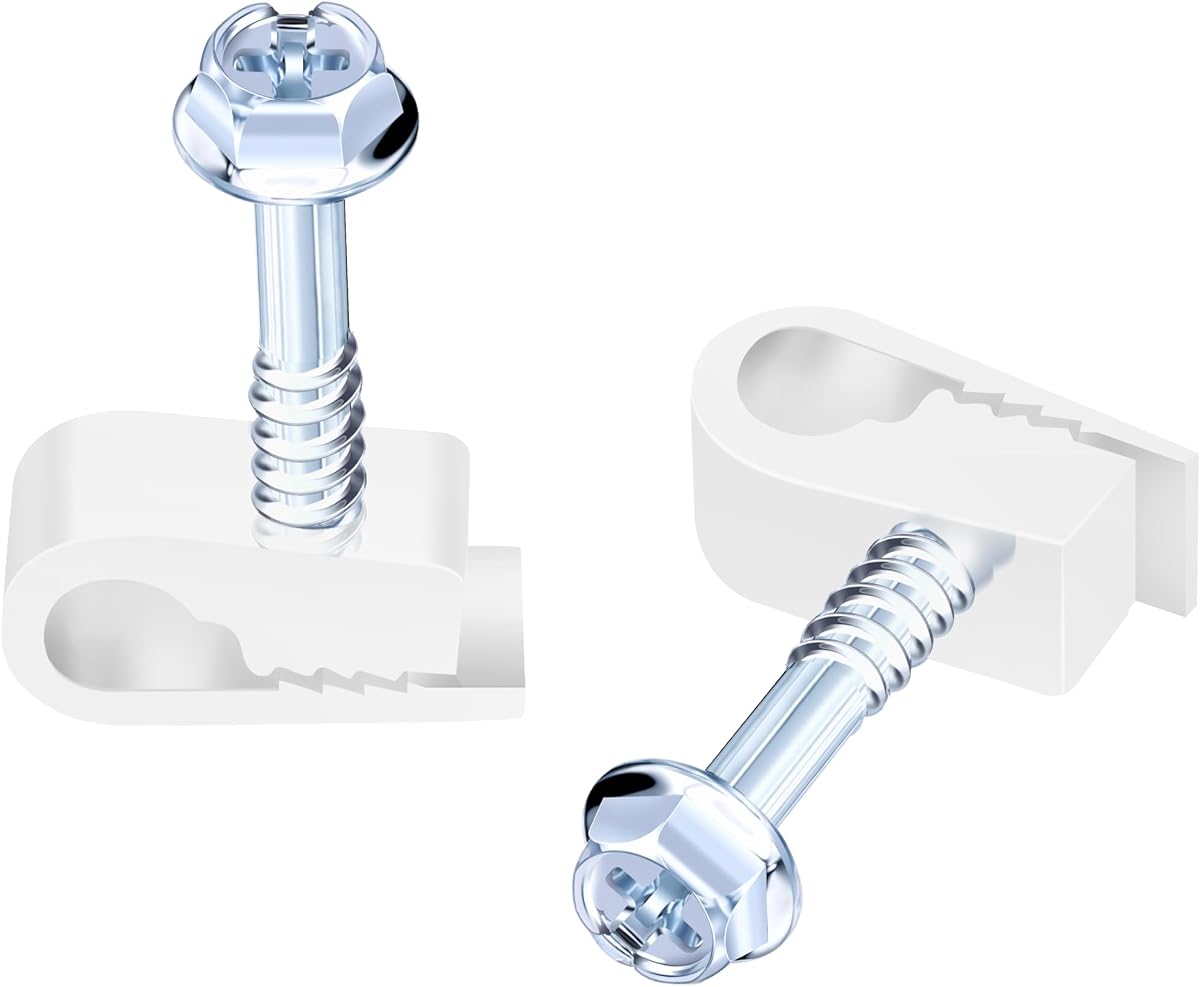


The 200 Pcs Cable Clips set combines four cable diameters with a generous quantity of nail-in mounts, making it one of the most practical choices for inexpensive, broad cable organization. Its 4.5 rating reflects a well-liked product whose main appeal is the flexibility to handle thin coax or Ethernet leads as well as thicker speaker and electrical cords.
We may earn a commission when you buy through this link, at no additional cost to you.
Each of the four sizes is represented by fifty clips, so a mixed cable project does not require separate orders for every diameter. The clips are made from stabilized plastic and use hardened nails intended to resist breakage during installation. Their one-piece pressing construction, long nails, and slip-resistant design focus on making each clip quick to place while helping it remain seated.
The trade-off is that this is a nail-in product rather than a screw-secured outdoor clamp. It is best suited to suitable wood surfaces, including baseboards, trim, and similar locations where the cable can be run neatly along the perimeter. It may not be the safest option for stucco, masonry, brittle vinyl siding, or exposed outdoor locations that require greater environmental resistance.
This set is a strong budget recommendation for households, offices, or installers who need many clips and several cable sizes. Home users can organize TV leads, USB cables, satellite wires, speaker cable, and computer power cords without committing to a complex mounting system. It is especially useful when a clean, inexpensive installation matters more than a fully weatherproof premium clamp.
Including 4 mm, 6 mm, 8 mm, and 10 mm options lets one purchase handle cables with noticeably different thicknesses. This reduces mismatches and makes the set practical for rooms containing several generations of cords.
The integrated nail design makes the clips convenient for short indoor runs along baseboards, door frames, and trim. A hammer or suitable driver allows repeated placement without handling separate fasteners.
We may earn a commission when you buy through this link, at no additional cost to you.
THE CIMPLE CO Black is a strong all-around selection for people who want dependable cable retention with a more substantial installation than a simple nail-in tack. It carries a 4.7 rating and pairs a UV-protected polyethylene clip with corrosion-resistant, yellow zinc-plated screw anchors, giving it a clear advantage for exposed exterior cable runs.
We may earn a commission when you buy through this link, at no additional cost to you.
Ridges inside the clip provide a 360-degree grip that adjusts to different cable sizes and resists sliding. The design is intended to avoid the pressure associated with staples, helping protect coax, Ethernet, electrical wires, and other cords from damage or potential signal and electrical problems. The screw head accepts both a quarter-inch hex driver and a Phillips driver, reducing dependence on one particular tool.
Pre-installed fasteners simplify setup, although screw mounting still takes more time than driving a nail into soft wood. Buyers should also consider the finish: black is visually unobtrusive against many dark or neutral surfaces, but it may stand out against white siding or pale trim. The clip remains one of the more balanced choices because it combines easy fastening with environmental and grip features.
This is an excellent recommendation for exterior coax, network, and low-voltage wiring, as well as indoor projects where a secure mechanical anchor is preferable. Installers can route multiple cable types without relying on adhesive, and the one-hundred-pack provides enough coverage for a substantial property or several rooms. It is particularly well suited to users who prioritize secure placement and outdoor suitability.
The internal ridges hold the cable while accommodating varied sizes. This approach favors controlled retention over the aggressive crushing sometimes associated with narrow metal staples.
Supporting both hex and Phillips drivers makes the pre-installed screws easier to work with across tool collections. Installers can use whichever driver provides the best control in a tight space.
We may earn a commission when you buy through this link, at no additional cost to you.
STEREN Coaxial Cable Clips specialize in the controlled routing of coax and other relatively small wires, with a 4.6 rating and adjustable gripping teeth at the center of the design. The clips are manufactured from durable polyethylene and are intended to hold a cable without applying harmful pressure.
We may earn a commission when you buy through this link, at no additional cost to you.
Grip clip technology is especially relevant to coaxial runs because maintaining a consistent cable position can help protect the signal path and avoid the damage associated with staples or overly tight fasteners. The teeth can expand to accommodate other wires, giving the clips some flexibility beyond a single coax size. Their pre-installed screws also make installation more convenient than an unfilled clip with separate hardware.
Compared with the broader weather-oriented design of the CIMPLE CO products, the STEREN listing focuses most clearly on coax, Ethernet, TV, and related wire routing. The supplied information does not make the same explicit outdoor material claims, so installers should judge the surface and exposure carefully. A pack of one hundred is useful for homes with numerous wall connections or a professional cable run.
This set is a good fit for television connections, antenna installations, desktop cable management, and home network runs where the cable should remain stable without sharp pressure. It is less obviously suited to oversized bundles than a saddle-style tie mount, but for individual coax and small wires, its adjustable grip and straightforward screw installation are compelling.
The expanding teeth allow the holder to accommodate compatible wires beyond one exact diameter. That versatility is helpful when a route includes a transition between coax and another lightweight cable.
Holding the cable in a defined channel reduces movement along the mounting surface. Controlled placement can help avoid accidental pulling, snagging, and repeated stress at the connector.
We may earn a commission when you buy through this link, at no additional cost to you.
The All-Weather Cable Clips set is designed for installers who need one clip to work across indoor trim and outdoor wall materials. Its 4.5 rating reflects a versatile design that accepts RG6, RG59, CAT6, CAT6A, extension cords, and other low-voltage cables with a stated adjustment range from approximately 3 to 7.5 millimeters.
We may earn a commission when you buy through this link, at no additional cost to you.
The UV-resistant polyethylene body and corrosion-resistant screw construction are important distinctions for exterior use. Adjustable ridges create a 360-degree gripping action, while the dual-drive screw head supports both hex and Phillips tools. The listing also describes specialized mounting approaches for brick, stucco, vinyl siding, and under-shingle routing, though the actual suitability of an anchor still depends on the surface and installation method.
The claim that installation can be faster than traditional staple placement is reasonable in principle because the screws are already installed, but the product still requires accurate positioning and a suitable driver. A smaller fifty-pack may also be less convenient than one-hundred-piece options for a whole-home installation. Its white finish is helpful on light trim but less discreet against dark materials.
This product is a strong candidate for exterior network or coax runs, seasonal lighting, and mixed-material homes. It is particularly attractive to users who want adjustable cable fit and weather-oriented construction without moving to a zip-tie saddle system. Confirm cable diameter and surface type before ordering, and use appropriate anchors when the base material requires them.
The stated use across baseboards, door frames, walls, brick, stucco, and vinyl siding makes this helpful for properties where a route crosses several materials.
UV-resistant polyethylene and corrosion-resistant fasteners provide a more thoughtful material specification for exposed runs. These features do not eliminate the need to choose anchors suited to the surface.
We may earn a commission when you buy through this link, at no additional cost to you.
Cable Matters Nail-in Clips deliver a clean, focused option for small round cables up to seven millimeters in diameter. The product has a 4.6 rating and offers 200 clips in a large pack, making it practical for multiple rooms, longer routes, or an installer who wants a substantial supply on hand.
We may earn a commission when you buy through this link, at no additional cost to you.
The curved holder combines with an integrated nail, allowing quick placement on suitable wood such as baseboards, trim, and door frames. The snug fit is intended to position compatible cables neatly without the visual bulk of conduit. Confirmed compatibility includes LMR 240, RG8X, RG58, RG59, RG6, Cat 5, Cat 6, 12 to 16 AWG speaker wire, phone wire, USB cable, slim video cable, and small electrical cords.
The limitation is the stated seven-millimeter maximum. Larger power cables, thicker bundles, and unusually substantial coax may not fit properly. Because the clip uses a nail, it is also better aligned with wood and similarly suitable surfaces than masonry, brittle siding, or exposed areas where a screw-secured or purpose-built anchor would be more dependable.
This is a strong recommendation for low-profile indoor organization around entertainment areas, offices, desks, and network equipment. It is especially useful when a large number of inexpensive, quickly installed points are needed. Buyers should measure representative cables before beginning and use the included container to keep the remaining clips together in a toolbox or workspace.
The compact holder keeps a single cable close to the surface. This is useful around molding and door frames where a larger raceway would be visually intrusive.
A seven-millimeter limit covers numerous familiar coax, Ethernet, speaker, phone, USB, and slim video cables. Measuring first prevents buying the wrong clip for thicker leads.
We may earn a commission when you buy through this link, at no additional cost to you.
HS Saddle Type Cable Zip Tie Mounts take a different approach from single-cable clamps by providing a fixed point around which several cables can be bundled. The kit includes 100 mounting bases, 100 six-inch nylon zip ties, and 100 screws, and its 4.6 rating reflects a well-regarded solution for structured cable routes.
We may earn a commission when you buy through this link, at no additional cost to you.
The bases are made from nylon 6/6, and the listing notes UL and RoHS certification. Installation requires securing each base and then passing the included ties around the desired bundle. This approach works particularly well for Ethernet, CAT5 through CAT7, television cables, Christmas lights, and wiring gathered beneath a desk, where separate single clips would require more mounting points.
A saddle mount is not the most discreet solution for one small cable, and the visible zip tie can make a run look more industrial than a compact clip. Screw placement also demands accuracy because the bundle is held by the strap rather than by a molded channel. Nevertheless, the system is highly adaptable and can accommodate several cable thicknesses or a future expansion of the same route.
This kit is a practical pick for offices, home theaters, workstations, and visible runs where grouping is more important than minimal visual impact. It is also useful for installers who want the flexibility to add or remove cables without replacing an entire anchor. Buyers should follow appropriate fastening practices for the wall, baseboard, or desk material.
The saddle base and long zip tie can hold multiple lines in one location. This reduces the number of anchors needed when several cables travel along the same route.
Each mounting base is supplied with a six-inch tie and screw. The standardized set simplifies inventory and makes it easy to plan future cable-management work.
We may earn a commission when you buy through this link, at no additional cost to you.
THE CIMPLE CO White shares the secure screw-mounted construction of the black version while offering a finish that blends more naturally with light-colored trim, siding, and walls. Its 4.7 rating and focus on a damage-conscious grip make it a compelling option for both indoor and outdoor cable management.
We may earn a commission when you buy through this link, at no additional cost to you.
The UV-protected polyethylene body resists outdoor exposure, while yellow zinc-plated screw anchors provide corrosion protection. Internal ridges create a 360-degree hold that adjusts to different cables and discourages back-and-forth movement. Because the screws arrive installed, the main installation task is positioning and driving the fastener rather than assembling each clip.
The white finish is the main distinction from the black model, and that difference can be important in a finished room. It may blend discreetly into white baseboards or siding, whereas a black clip can provide a similarly understated effect against darker surfaces. Users should consider the overall visual plan rather than assuming one finish suits every environment.
This product is well suited to coax, CAT Ethernet, electrical wire, and low-voltage exterior connections. It is a good selection for installers who value secure placement, broad driver compatibility, and a low-profile finished appearance. It is less convenient than a nail clip for quick work on soft wood, but the added mechanical security makes it preferable where movement or exposed conditions are concerns.
The white body is suited to pale walls, trim, and siding where a black clip would stand out. It provides the same functional clip-and-screw layout for a more coordinated finish.
A screwed body remains mechanically fixed to the mounting surface. Combined with ridged internal edges, this helps keep the cable positioned through indoor use and outdoor exposure.
We may earn a commission when you buy through this link, at no additional cost to you.
Skywalker Flexible Single Cable Screw Clips have the highest rating in this group at 4.8 and distinguish themselves through a flexible polyethylene design intended to avoid constricting, pinching, or damaging cable. The material can also be customized, making it practical when a standard one-size channel does not suit a particular routing angle.
We may earn a commission when you buy through this link, at no additional cost to you.
The built-in screw secures RG-6 cabling in a neat, professional route, particularly along baseboards and around door frames. A half-inch screw depth is specified, so the product is best used where that penetration is sufficient. Flexible polyethylene offers controlled positioning while remaining gentle on the cable jacket, a useful characteristic for installations that may be adjusted later.
The main limitation is that the product information is most specific about RG-6, so buyers with coax, Ethernet, speaker, or other cables should confirm fit before committing. The relatively short screw is also less adaptable to deeply textured masonry than a longer fastener or a specialized stucco clip. Its pack quantity is generous, but installation remains a two-handed task involving a driver.
This is the premium recommendation for installers who value subtle routing, a professional appearance, and a material designed to protect the cable. It fits neatly into pre-wire or after-build applications around common finished surfaces. For a standard RG-6 connection or similarly sized cable, the combination of a 4.8 rating, flexible construction, and integrated screw hardware makes this a particularly refined option.
The polyethylene body can conform around a cable instead of forcing it against a rigid edge. This supports a gentler hold while maintaining a defined route.
A compact black clip with an integrated fastener creates a controlled run along trim and baseboards. It suits spaces where visible cable hardware should be minimal but dependable.
We may earn a commission when you buy through this link, at no additional cost to you.
XHF Saddle Mounts offer a flexible method for holding grouped cables with eight-inch zip ties. The complete set contains 100 bases, 100 ties, and 100 tapping screws, while the 4.7 rating places it among the stronger-rated products in the roundup.
We may earn a commission when you buy through this link, at no additional cost to you.
The mounting bases are manufactured from nylon identified as RoHS compliant and intended for both indoor and outdoor environments. Their length and shape accommodate applications involving computer cables, television cables, Christmas lighting, USB cables, and other grouped wiring. A tapping screw helps secure the base, after which the cable bundle is enclosed by the supplied tie.
Compared with a six-inch saddle system, the eight-inch tie offers more room for multiple lines or a broader bundle. The trade-off is visibility and the need to tighten each strap evenly. This method is less suitable for a single delicate wire where a compact clip would look cleaner or exert less unnecessary restraint. The supplied information also does not specify a UV rating, so prolonged direct sunlight deserves consideration.
The XHF set is a good choice for home offices, entertainment areas, holiday-light installations, and general route consolidation. It is particularly useful when the cable path may evolve and a larger bundle is possible later. Shoppers should pair the base with an appropriate fastener for the surface rather than assuming a tapping screw is suitable for every wall material.
Eight-inch ties create additional circumference compared with shorter options. That extra capacity helps when several lines share a route or a new cable may be added later.
The equal quantities of bases, ties, and screws simplify installation planning. A complete set is also convenient for contractors working across multiple properties or rooms.
We may earn a commission when you buy through this link, at no additional cost to you.
Skywalker Stucco Clips are purpose-built for exterior cable routing on stucco homes, replacing a general-purpose clip with a manganese steel design made to engage the mesh behind the surface. The 4.5 rating reflects a specialized solution with clear advantages for installers who routinely work on stucco.
We may earn a commission when you buy through this link, at no additional cost to you.
Installation is unusually direct: the clip is pushed into the stucco, where it opens and its teeth attach to the mesh wire behind the outer layer. Because the clip secures itself, there is no separate screw or anchor in the basic workflow. The steel construction is specifically described as able to withstand hot summer temperatures, an important consideration on exposed exterior walls.
This specialized design does not transfer directly to drywall, wood, brick, or other surfaces, and the push-in process requires accurate placement. Users should avoid forcing the clip into areas where the expected mesh is not present. The hidden gripping mechanism also deserves care during removal, since levering against a rigid stucco face could damage the clip or the wall finish.
This product is best recommended for exterior coax, network, lighting, and other cable runs on stucco construction. It is especially useful for homeowners or installers who understand the surface and want a clip that uses the wall's existing support structure. For anyone unsure whether the stucco contains suitable mesh, consulting an installation professional is prudent.
The teeth are designed to catch mesh behind stucco, offering a secure result that ordinary surface screws may not provide in the same way. The method is tailored to the wall construction.
Manganese steel provides a durable alternative to plastic in hot exterior conditions. That makes the clips relevant to climates where sunlight can raise surface temperatures substantially.
We may earn a commission when you buy through this link, at no additional cost to you.
Choosing a cable anchor clip involves balancing cable diameter, mounting surface, exposure, cable quantity, appearance, and installation effort. The most important step is identifying the cable and surface before selecting a fastening style.
Cable diameter is the first practical constraint because a clip that is too small can pinch the jacket or fail to open, while one that is too large may let the cable move, twist, or fall out. Measure the outside diameter of the cable rather than relying only on its category or brand. Some listings specify several sizes, such as 4 mm, 6 mm, 8 mm, and 10 mm, while others focus on a narrower range, such as 3 to 7.5 mm or a maximum of 7 mm. Coax, Ethernet, speaker wire, USB leads, and power cords can all differ significantly in thickness.
Choose the stated clip range only when the measured cable falls comfortably within it, and check whether the product is designed for round or flat cable when relevant. The short version is simple: measure first, then confirm the listing's dimensional limits.
Nail-in clips are quick and economical on suitable wood, but screw clips generally offer more controlled security and greater flexibility across surfaces. Saddle-style mounts suit bundled cables, while push-in stucco clips rely on hidden mesh. A broad-purpose screw clip may be useful across drywall, wood, concrete, brick, or siding when paired with the correct anchor, but no fastener should be assumed to suit every material. Consider the tool, the anchoring depth, and the strength of the surface.
In short, use nails for convenient wood installation, screws for secure general routing, saddles for bundles, and a specialized clip for stucco mesh.
Outdoor cable clips need resistance to ultraviolet exposure, moisture-related corrosion, temperature changes, and repeated outdoor movement. The listed CIMPLE CO and all-weather products explicitly emphasize UV-protected or UV-resistant polyethylene and corrosion-resistant screws. The STEREN product is primarily presented for coax and wire routing, while the STEREN and black options share a clip body and mounting approach but differ mainly in color. The XHF saddles are described as suitable for indoor and outdoor environments, but the listing does not provide a specific UV rating, so the level of exposure still matters.
Choose outdoor-rated construction for exposed runs, and use appropriate surface anchors. Indoor-rated clips can work for covered locations, but they are not automatically suitable for rain, sun, and seasonal temperature changes.
A useful clip should retain the cable without cutting, crushing, or abrading its outer jacket. The 360-degree ridged grips in several screw-mounted products are intended to distribute contact and reduce sliding. The flexible body of the Skywalker product is specifically designed to avoid constriction, while the STEREN grip technology focuses on preventing harmful pressure. Metal staples can be narrow and sharp, so clips that create a broader channel may offer a gentler result. The best choice is not simply the tightest holder but the one that keeps the cable centered without deforming it.
Look for rounded edges, flexible or ridged contact points, and an opening that accommodates the cable naturally. Confirm that a snug fit does not mean a damaging clamp.
Single-cable clips create a clean route for one line at a time and are generally the neatest option around door frames, television connections, network runs, and desk cords. Saddle mounts accept multiple cables, which can reduce the number of anchors needed and simplify a shared route. A zip-tie system also allows users to add or replace cables without changing the mounting base. The trade-off is bulk and visual prominence. If the installation will remain visible in a finished room, single clips are usually more discreet; if several cables follow one common path, a saddle may be more efficient.
Choose single clips for a refined individual route and saddle mounts for consolidation. Consider how the arrangement will look after the cables are added.
Pack size should reflect both the number of attachment points and the number of cables. A 200-piece nail-clip set is economical for a large home or multiple small cables, while 50- and 100-piece packs are more manageable for focused installations. Saddle kits contain three parts per location, so the stated total of 100 sets represents 100 bases, 100 ties, and 100 screws rather than 100 small components. Buyers should also consider whether all four nail-clip sizes are needed; mixed-size packs are versatile, but a single-size pack can be less wasteful when every cable is identical.
Estimate anchor points, add a small reserve for mistakes or future changes, and then compare pack composition. The right quantity reduces both leftover clutter and repeated orders.
Color affects how visible a cable route becomes after installation. Black clips tend to blend with dark trim, electronics, and shadowed areas, while white clips can disappear against pale walls, siding, and baseboards. Neither color is inherently stronger, so appearance should be separated from performance. A low-profile black clip may still be noticeable on white drywall, and a white clip can stand out against brick or dark stone. If the route crosses several surfaces, neutral clips or a mix of finishes may create the most balanced appearance.
Choose the finish that matches the dominant surface, especially in occupied rooms. Material and grip should still take priority over color when durability is the main concern.
Nail-in clips require a hammer and are the easiest option for repeated placement in suitable wood. Screw clips require a compatible driver, with some products supporting both hex and Phillips styles. Push-in stucco clips need accurate positioning and may involve a short learning curve because the clip opens and grips hidden mesh. Saddle systems also use screws but add a second step as the zip tie is threaded and tightened. Consider whether the wall surface permits the stated fastener and whether the cable route can be installed without stretching the cable or crowding other fixtures.
Match the installation method to your comfort level and tools. More secure mounting is valuable only if it can be installed correctly.
Begin by planning the route. Identify the cable diameter, inspect the mounting surface, and position each clip so the cable follows a straight, accessible path without creating a sharp bend, tension, or interference with doors, windows, furniture, and moving parts. Dry and clean the surface before installation, especially for exterior stucco, siding, or brick, because dirt and loose material can affect how a clip or screw seats.
Install one clip at a time and check the fit before securing the rest. For a nail clip, hold it over the cable opening and drive the nail squarely into suitable wood. For a screw clip, place the cable inside the ridged channel, align the fastener, and drive it using the supported driver style. Keep a safe distance from concealed wiring and pipes, and use anchors appropriate to masonry or other nonstandard surfaces.
After installation, inspect each clip for full seating, gentle cable contact, and a secure connection to the wall. Avoid pulling cables by the anchored section, and periodically check outdoor fasteners for movement or corrosion. Replace a clip that cracks, slips, or deforms rather than forcing a mismatched cable into it. Removing a stucco clip requires care because its teeth are designed to engage the hidden mesh.
They can be, but the clip and its fastener should both be appropriate for outdoor exposure. Look for UV-resistant plastic, corrosion-resistant screws, and a clip that forms a stable channel around the coax without crushing it. Also confirm that the mounting surface and anchor are suitable for the location.
Nail-in clips are faster and often easier on suitable wood surfaces. Screw-mounted clips take more time but provide a more controlled mechanical connection and are often more versatile across drywall, trim, masonry, and siding when the correct anchor is used. The best choice depends on the surface and how firmly the cable needs to be retained.
Measure the cable's outside diameter and compare it with the manufacturer's stated range. Pay attention to the maximum diameter and whether the clip is intended for round or flat cable. A snug fit should hold the cable in place without flattening, cracking, or excessively pinching its jacket.
Saddle-style mounts and zip-tie bases are intended for bundled cables, while most single-cable clips are designed for one line. A standard single clip should not be forced around a large bundle because the extra load can distort the clip or damage the cables.
Adhesive options can be convenient on smooth surfaces, but screw-mounted clips generally provide a stronger mechanical attachment and are easier to remove without potentially leaving residue. Surface preparation, environmental exposure, and cable weight can also affect adhesive performance.
General-purpose clips require an anchor or screw appropriate for stucco, while the dedicated Skywalker manganese steel clips are designed to push into the surface and engage mesh behind it. Confirm the wall construction and follow the product-specific instructions to avoid cracking or damaging the finish.
A properly sized clip with smooth or ridged contact points should not damage a cable. The risk increases when a clip is too small, forced closed, or tightened in a way that constricts the jacket. Leave enough room for movement and inspect the cable if it shows flattening, cracking, or sharp pressure marks.
Common locations include baseboards, door frames, wall trim, the backs of desks, and exterior siding or stucco. Place clips at consistent intervals, keep connectors and service loops accessible, and avoid areas where doors, furniture, wind, or foot traffic could pull on the cable.
The 200 Pcs Cable Clips offer the strongest budget value because four cable sizes and 200 nail-in clips cover many ordinary indoor jobs. THE CIMPLE CO Black is the editor's choice for secure screw-mounted routing, and the black or white version suits both dark and light finishes. The Skywalker Flexible Single Cable Screw Clips stand out as the premium option with their 4.8 rating, gentle flexible body, and discreet installation.
The most important choice depends on the project. Use nail-in clips for efficient organization on suitable wood, screw clips for stronger retention and broader surface options, saddle mounts for cable bundles, and a stucco-specific clip when a route crosses stucco construction. Always verify cable diameter, environmental exposure, fastener suitability, and appearance before ordering.
Ratings, product configurations, availability, and pricing can change, so check the current listing and included components before making a final purchase. Confirm the exact clip range, quantity, color, material, and mounting hardware to ensure the product matches the planned cable route.